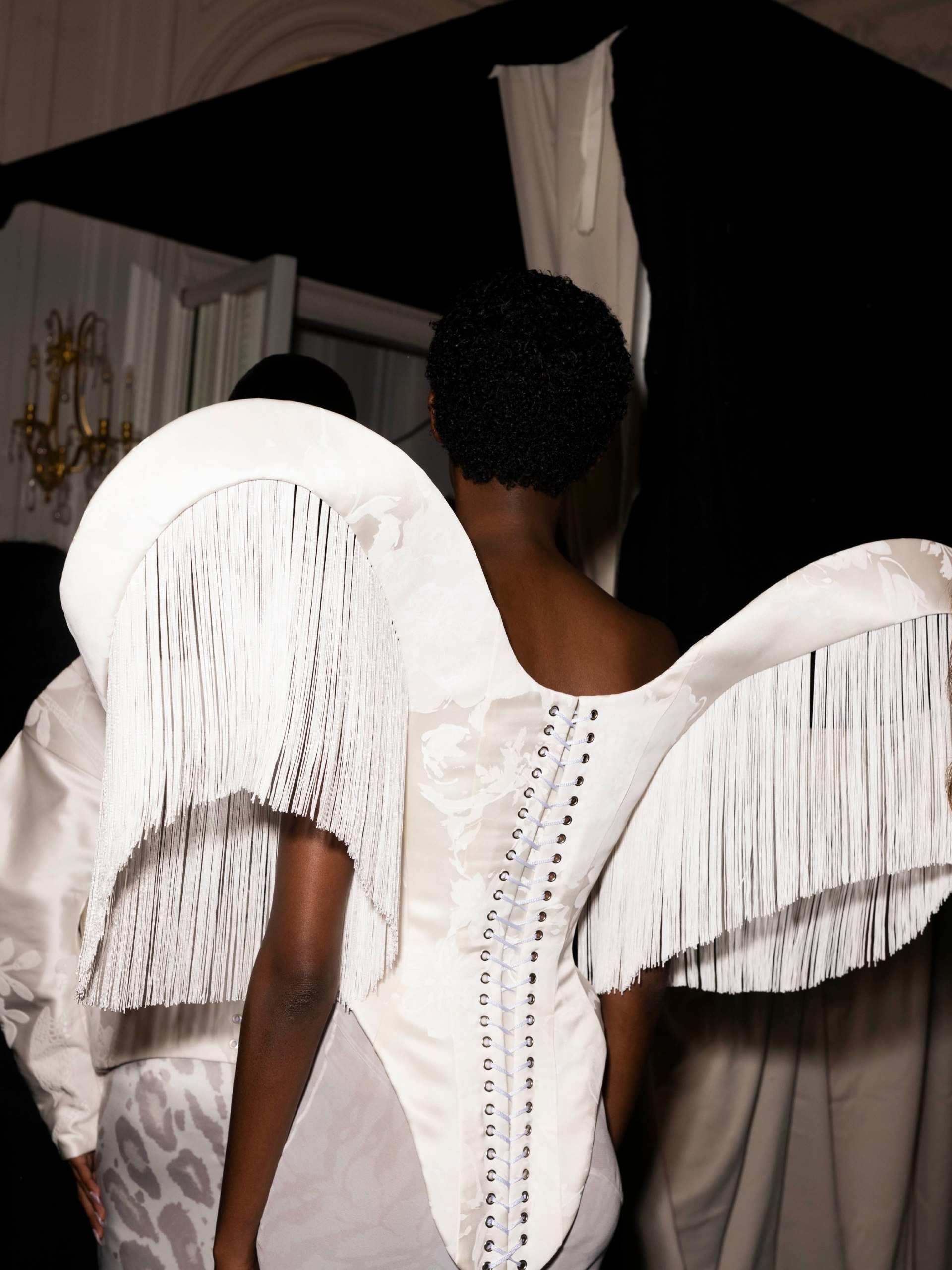
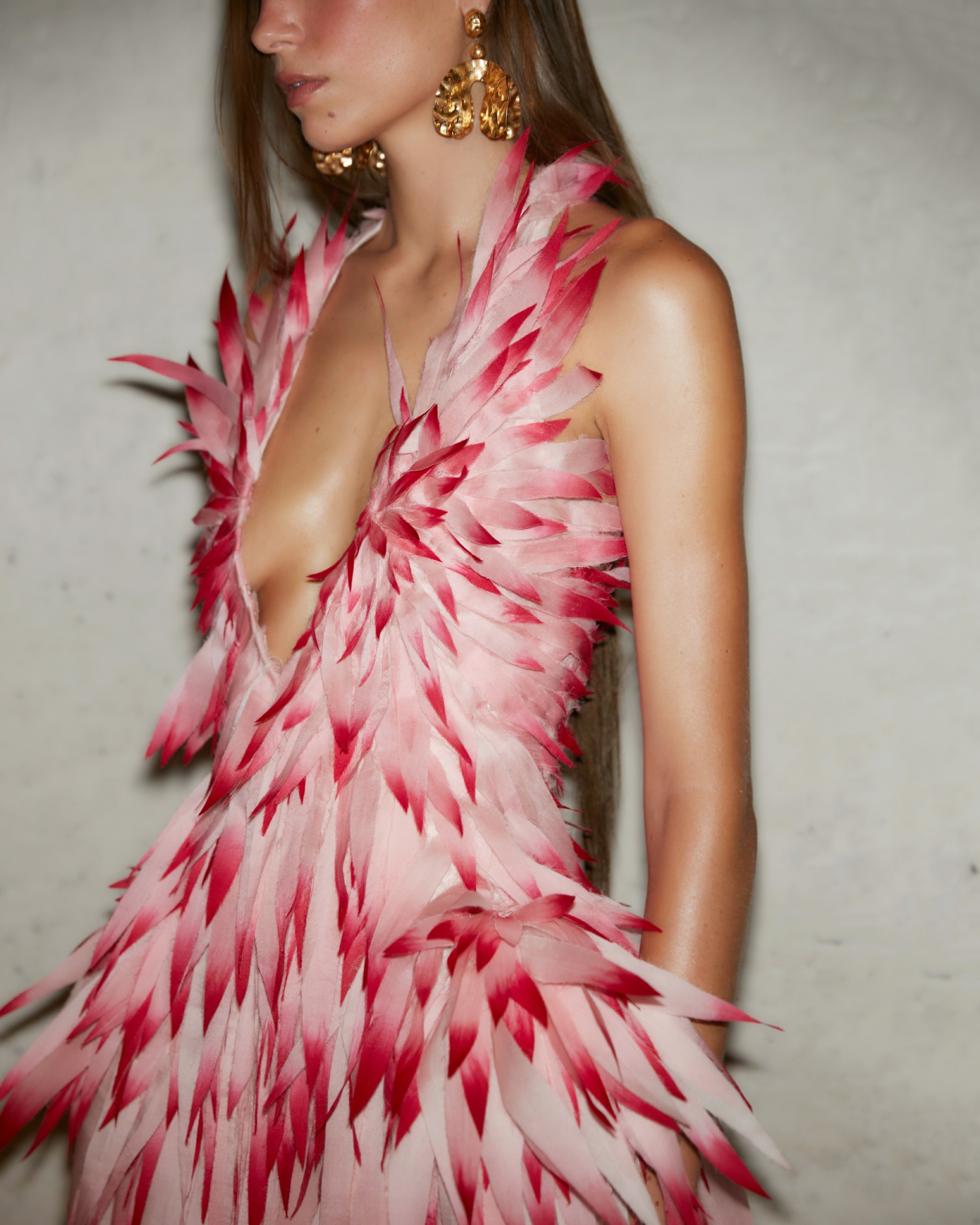
Kate Moss got married exactly once, in a beaded John Galliano slip dress in a small Cotswolds church in 2011, and that single look is still one of the most referenced bridal moments of the last two decades. But treating that as her only contribution to bridal style massively undersells the archive. Across three decades of runway shows, red carpets, and party photos, she’s worn tartan wedding gowns, sheer lace, crystal-covered minis, corsetry, veils, and enough beading and fringe to outfit several very different brides. Some of it, like her Westwood and Versace runway looks, was built as a designer’s own bridal idea; the rest wasn’t bridal at all on paper, and somehow works just as well. Nearly all of it still gets pulled up on mood boards today. What follows is a tour through the pieces worth saving, look by look.
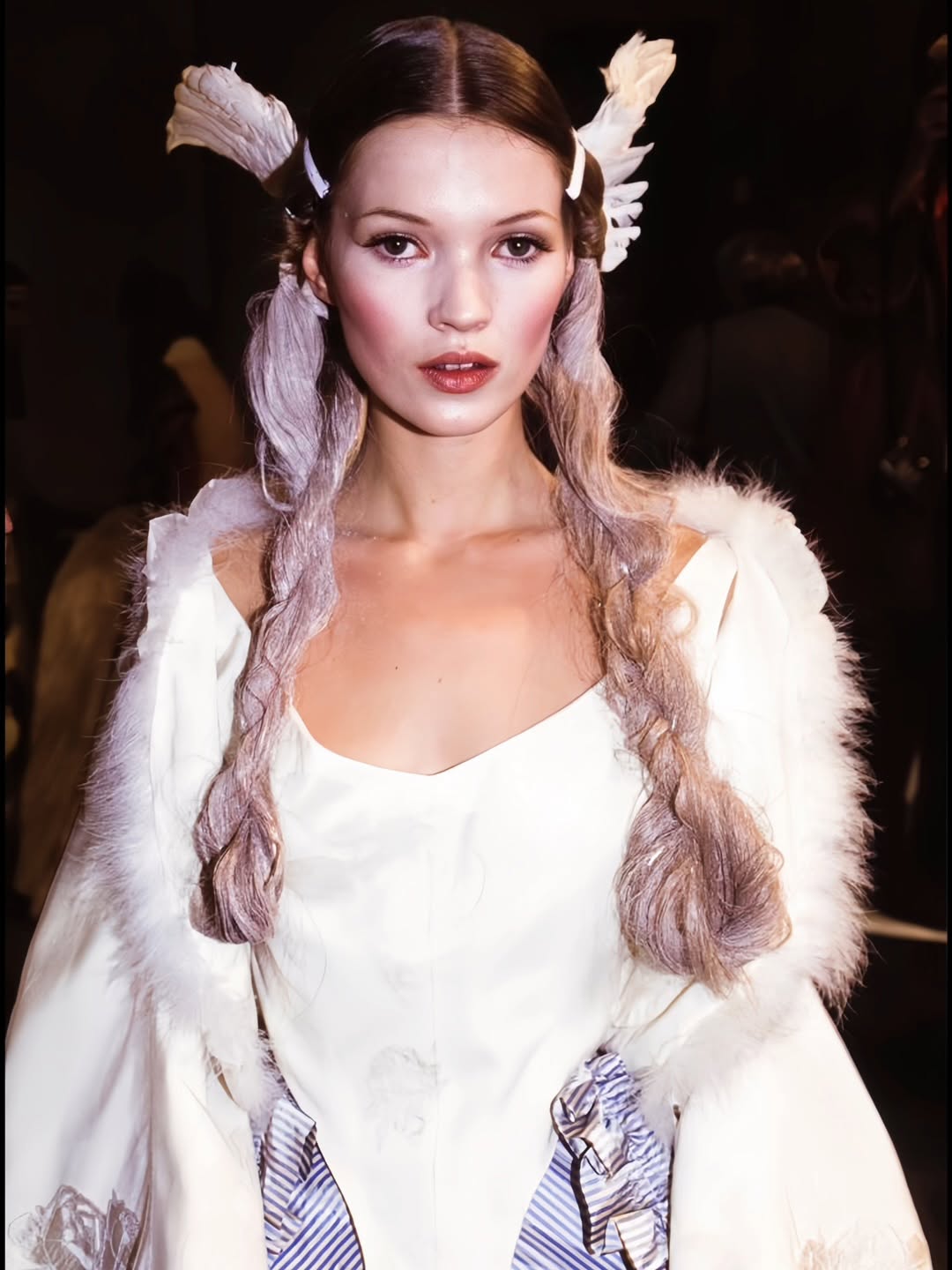
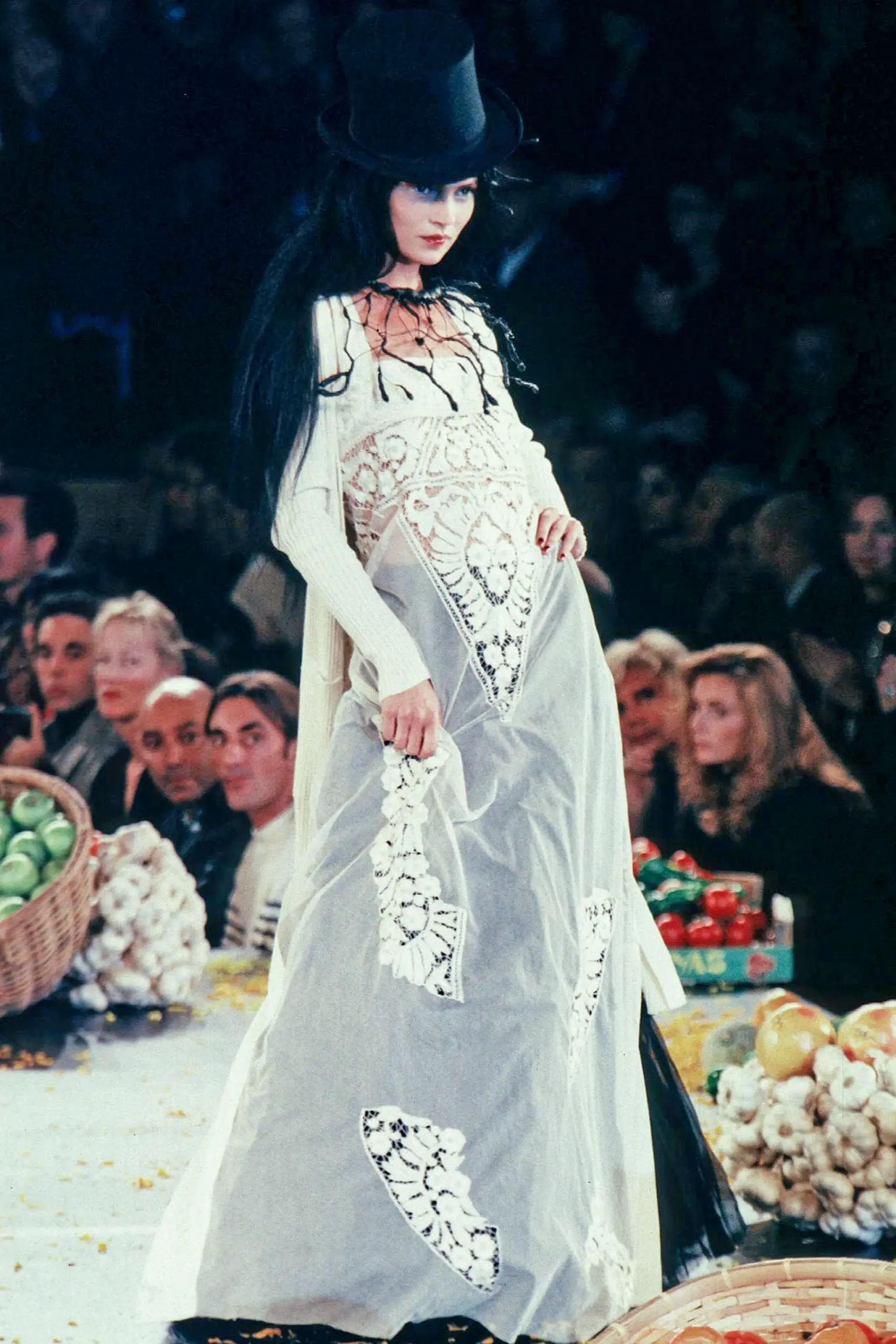
Photo: Pool ARNAL/PAT, Victor VIRGILE/Getty Images
Versace, SS95 & Haute Couture AW95
If you’re curious what the Versace bride looks like, take a look at Kate Moss closing Gianni Versace’s Fall/Winter 1995 couture show in a crystal-encrusted, zip-front mini dress paired with a matching crystal headband and a sheer bridal veil, bouquet in hand. It’s remembered as one of the most referenced bridal beauty moments of the whole decade; the encrusted headband alone is often credited as an early ancestor of the 2000s headband trend. The dress had a real second life recently, too: Dua Lipa wore the actual vintage piece (minus the veil, plus matching crystal zip-front boots) around her own engagement to Callum Turner in 2026, styling it as a knowing nod to Moss’s original bridal moment.
Moss also walked Versace’s Spring/Summer 1995 runway in a white satin corset with a laced front and floral embroidery, paired with matching floral briefs. It’s a much more stripped-back look than the couture bride, corsetry and lingerie-as-outerwear being one of Versace’s defining moves throughout the 90s, worn with total confidence and almost no additional styling to soften it. It’s also a genuinely useful reference point for a bride’s getting-ready shoot. It’s exactly the kind of energy Shay Sullivan brought to her own wedding-morning photos, getting ready in a Mirror Palais corset top paired with Fait par Foutch shorts, a combination that read so coquette.
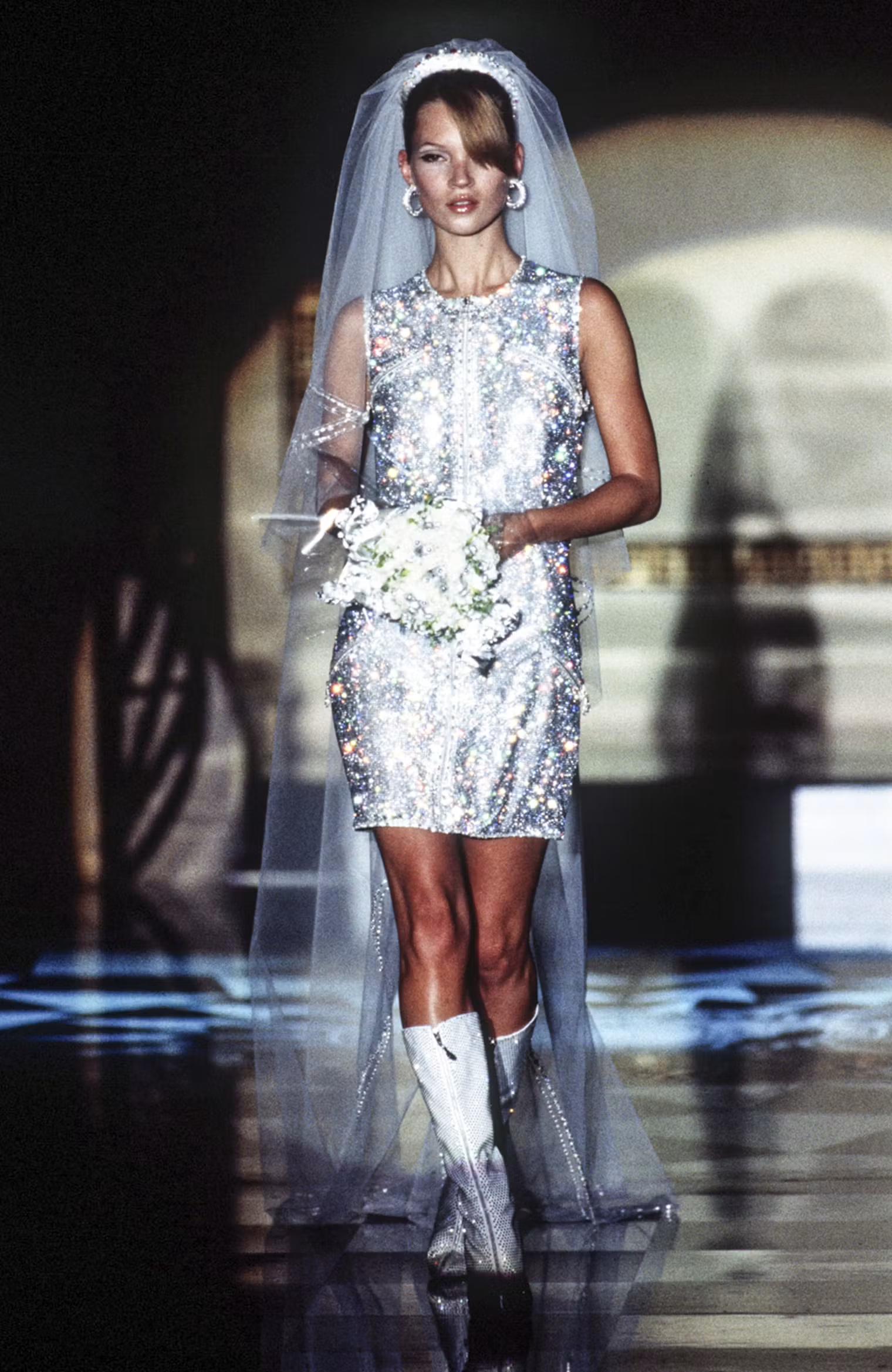
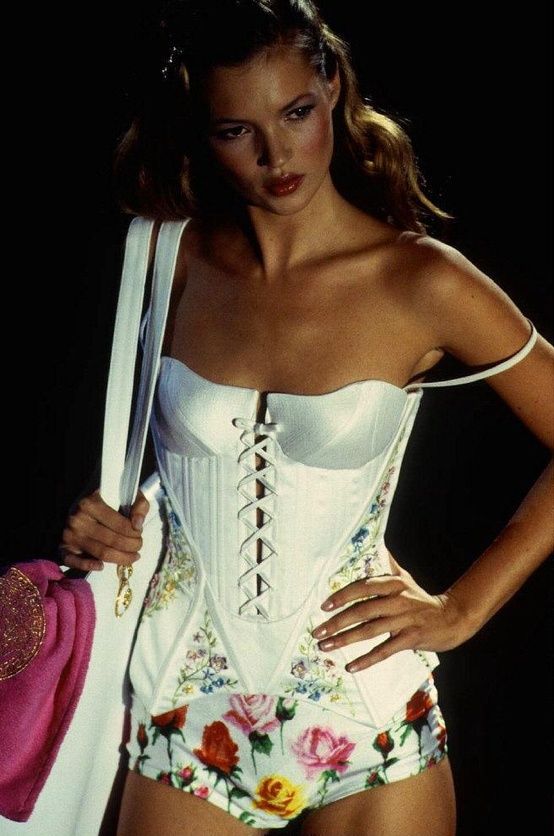
Photo: Victor VIRGILE/Getty Images, Getty
John Galliano, SS94 & SS96
Few designer-muse relationships in fashion run as long or as deep as the one between Kate Moss and John Galliano. He gave her a runway debut at just 15 years old, in his Spring/Summer 1990 show, and she went on to walk for him across nearly every era of his career, his own label through the 90s, his stint at Givenchy, and later Christian Dior. Along the way, he gifted her a white slip dress for her 21st birthday that she wore to the 1995 CFDA Awards, designed her wedding gown when she married Jamie Hince in 2011, and, decades later, as creative director of Maison Margiela, built her a custom lamé and tulle gown for Vogue World: London in 2023. Two of the most iconic stops along that long collaboration came early on, both from his own label in the mid-90s.
John Galliano’s Spring/Summer 1994 collection was built as a full fashion fairy tale, drawing on a Vanity Fair article about the remains of the Romanovs and the myth of the lost Princess Anastasia, Tolstoy’s “Anna Karenina,” Jane Campion’s “The Piano,” the Duke of Edinburgh, and Madeleine Vionnet’s 1920s bias cut. Kate Moss was essentially transformed into a Russian princess for the show: the striped voluminous skirt, a deconstructed bodice, the tousled braids threaded with feathers, the whole romantic, folkloric silhouette.
Two years later, Galliano created the Spring/Summer collection titled “The Dance School” and leaned fully into a ballet theme. The tulle skirt Moss wore reads almost like a tutu pulled straight off a rehearsal room floor and onto the runway, finished with a sculptural headpiece and slim, strappy sandals that kept the rest of the look from tipping into full-costume territory.
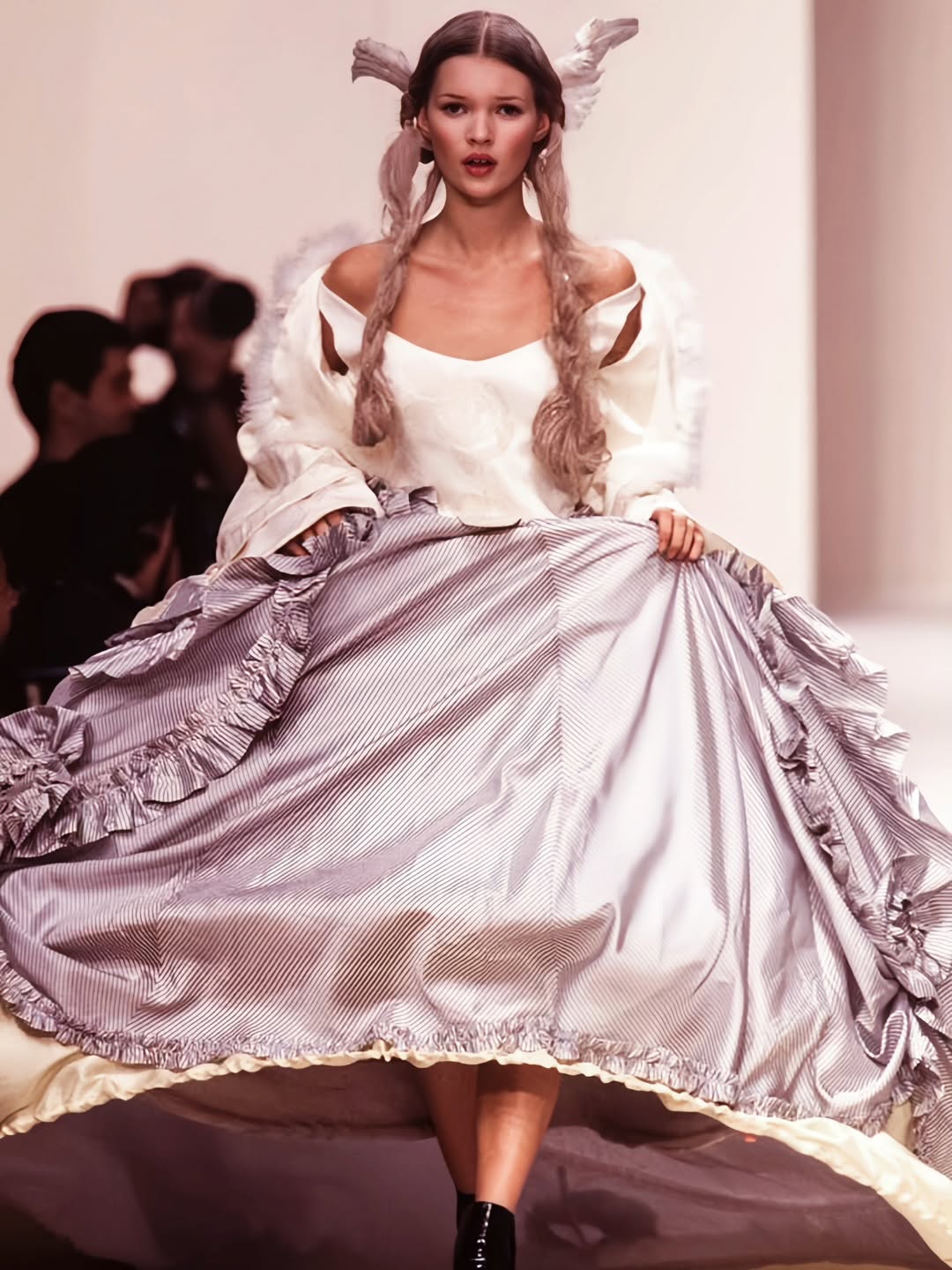
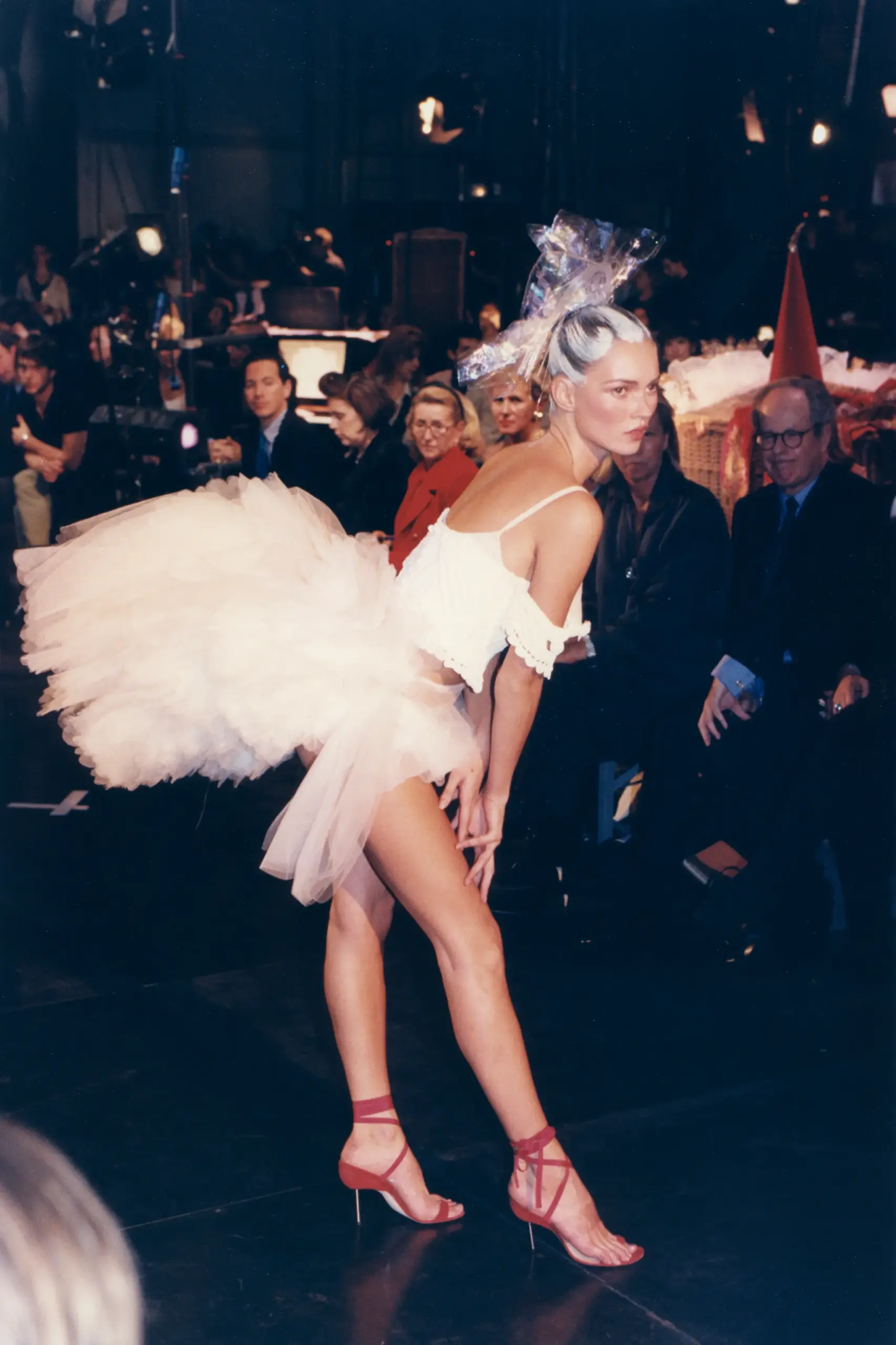
Photo: Pool ARNAL/PAT
Vivienne Westwood, FW93 & SS96
Kate Moss closed Vivienne Westwood‘s Fall/Winter 1993 “Anglomania” show in a tartan wedding gown, off-the-shoulder with dramatic puffed sleeves, a matching tartan veil, and Westwood’s signature orb brooch pinned at the chest, bouquet in hand. It was the first piece ever made in the MacAndreas tartan, a print Westwood had designed and had officially registered with Lochcarron of Scotland that same year, a process that usually takes closer to two hundred years. The show, presented in Paris that March, opened what’s now known as Westwood’s Gold Label era and remains one of the most referenced moments of her archive.
Vivienne Westwood’s Spring/Summer 1996 collection took its cues from Marie Antoinette’s portraiture and the paintings of Watteau, leaning into a softer, more ladylike register than some of Westwood’s more exaggerated seasons. Moss’s look, a corseted ivory and beige pinstriped gown with short puffed sleeves and a full, round skirt, fits that historical, portrait-like sensibility, tightly laced through the bodice before dropping into a dramatic, full 18th-century-inspired skirt.
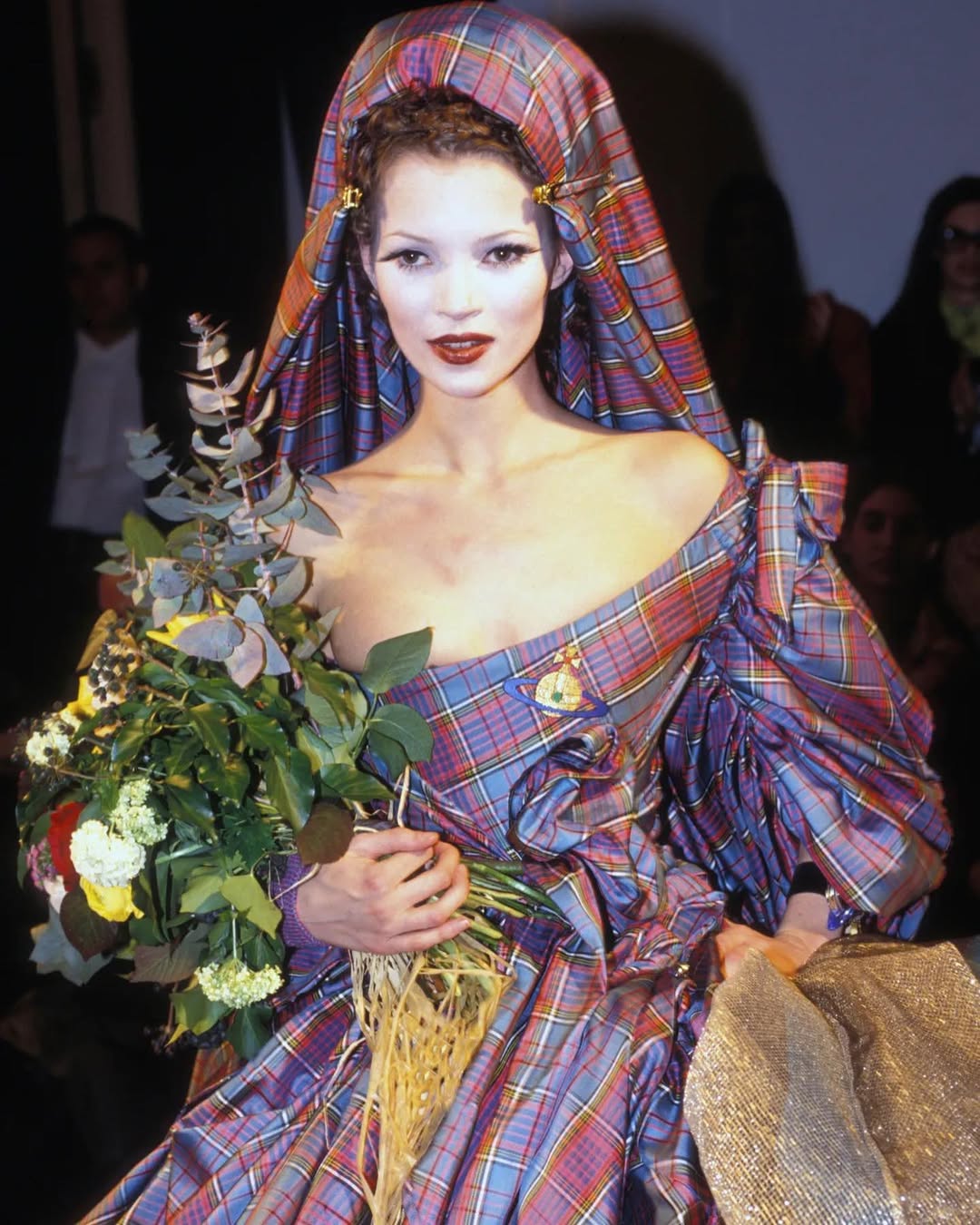
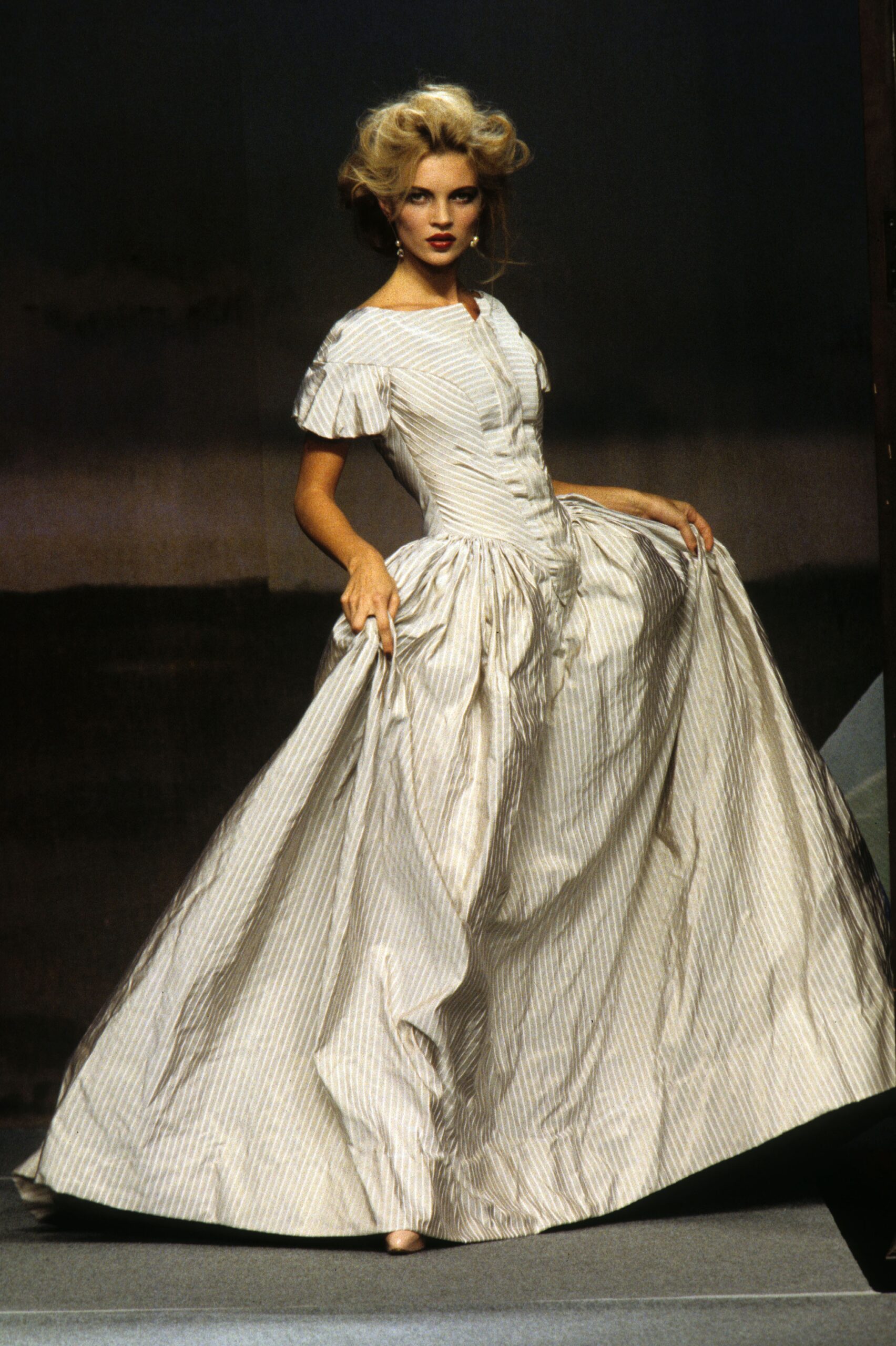
Photo: Pool ARNAL/GARCIA, Victor VIRGILE/Getty Images
Met Gala, 1993 & Cannes, 1998
At her first-ever Met Gala, Kate Moss wore a butter-yellow Calvin Klein slip dress on spaghetti straps and essentially defined a minimalist era in a single outfit. The look embodied what has since been described as “sexy nonchalance” — a quality impossible to manufacture and immediately recognizable when it’s real. The slip dress, borrowed from lingerie and stripped of everything superfluous, worn like it required no effort at all. Which was, of course, the whole point.
Kate Moss attended the opening night of the 51st Cannes Film Festival on May 13, 1998, for the premiere of “Primary Colors,” in a white slip dress by Grès Paris, designed by Lloyd Klein. She arrived alongside fellow supermodel Claudia Schiffer, and by most contemporary accounts, the two of them drew more attention from photographers on the red carpet that night than most of the film’s own cast. It’s a good example of Moss’s now-signature approach to eveningwear even that early on, a simple, body-skimming slip dress doing more with less than a fully built-out gown could.
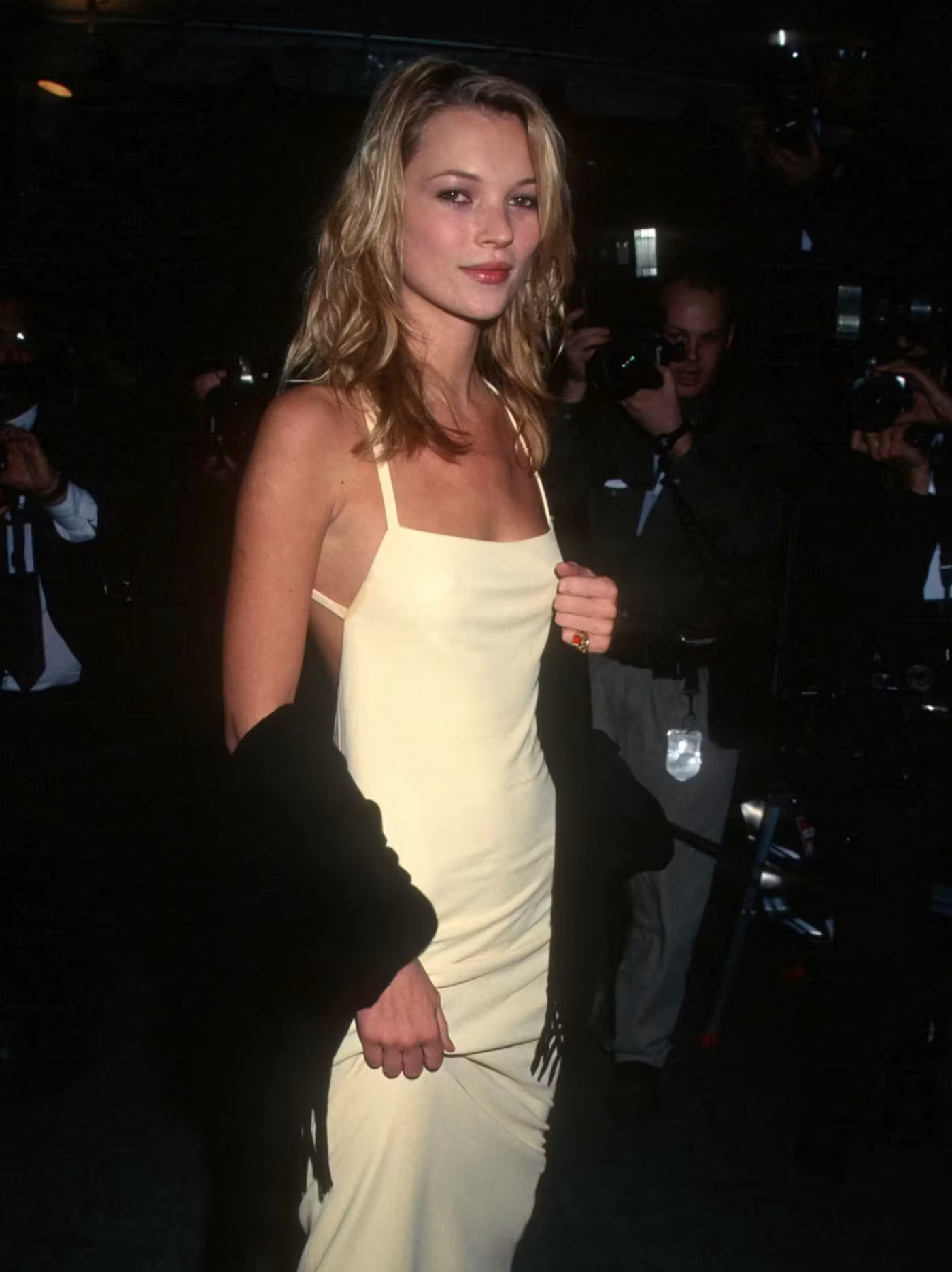
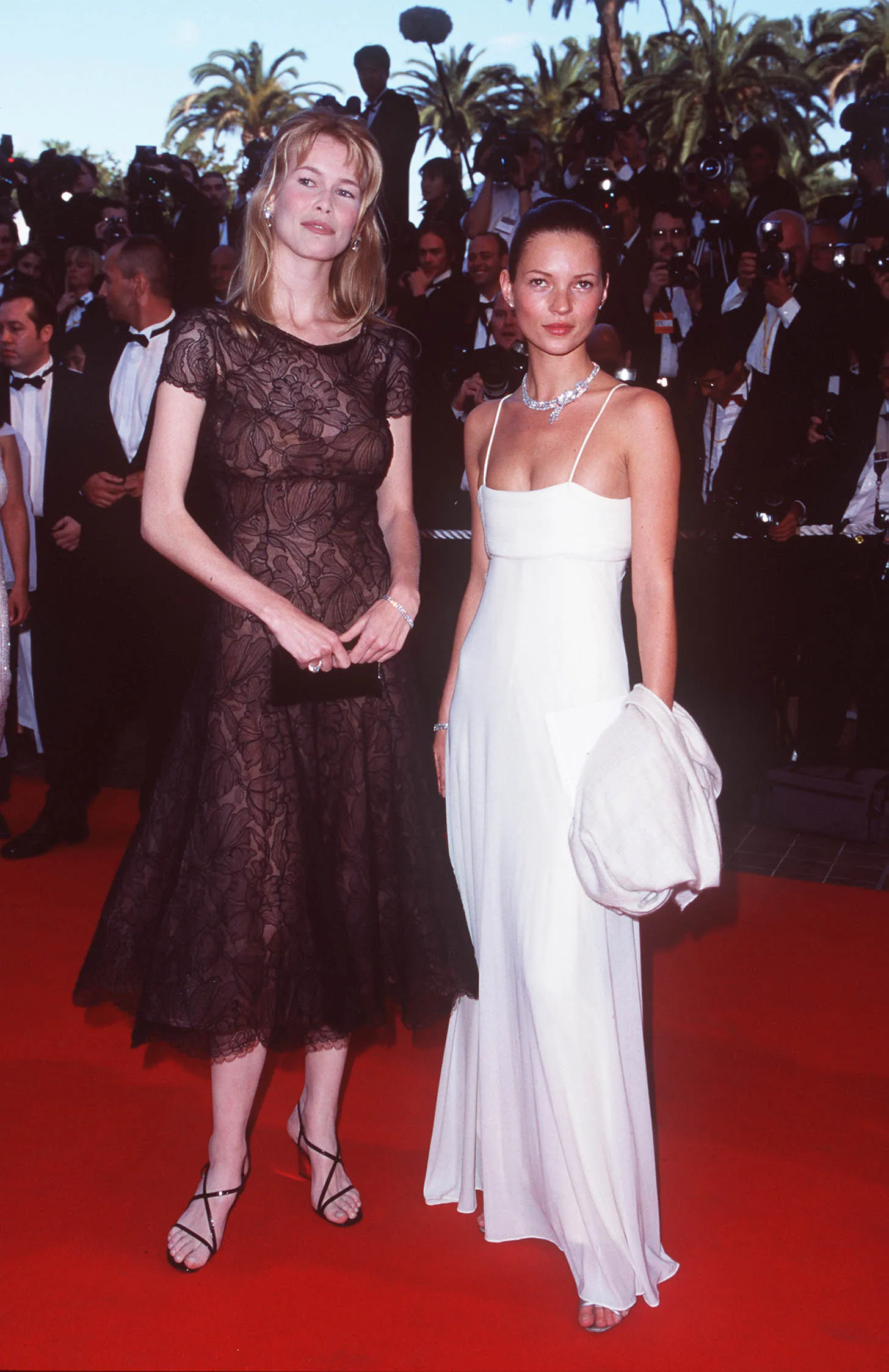
Photo: Ron Galella/Getty Images, Steve Granitz
Tom Ford, SS96 & FW96
In 1996, Tom Ford was the creative director of Gucci, and his influence was impossible to overstate. He took an Italian house that had lost its way and gave it desire. Under Ford, Gucci defined the era of sexy sophistication, where power and glamour mix in the coolest way possible.
The whole period was built around a specific idea: sexed-up femininity delivered through sheerness, plunging necklines, and low-slung cuts rather than outright nudity, and the lace mini dress from Gucci’s Spring/Summer 1996 runway show is a pretty direct expression of exactly that. The dress itself is a sheer white lace mini, with long flared sleeves, a round neckline, and a scalloped hem, worn over nude-toned underwear so the lace read as see-through rather than fully bare. That was a classic Ford move: not outright nudity, but something glimpsed through lace, which somehow read as more provocative than actual exposure. Kate Moss carried the look through in the accessory too, a version of Gucci’s signature bamboo-handle bag done in fluffy white shearling instead of leather, a fashion-forward update on one of the house’s oldest, most recognizable pieces.
If the Calvin Klein slip dress was minimalism as restraint, the Tom Ford for Gucci Fall/Winter 1996 white jersey gown was minimalism as provocation. Spaghetti straps, a square neckline, a figure-hugging silhouette — and then those two side cutouts, through which a contoured gold G-buckle belt was perfectly framed against bare skin. Vogue called the show “the fashion equivalent of a one-night stand at Studio 54.”
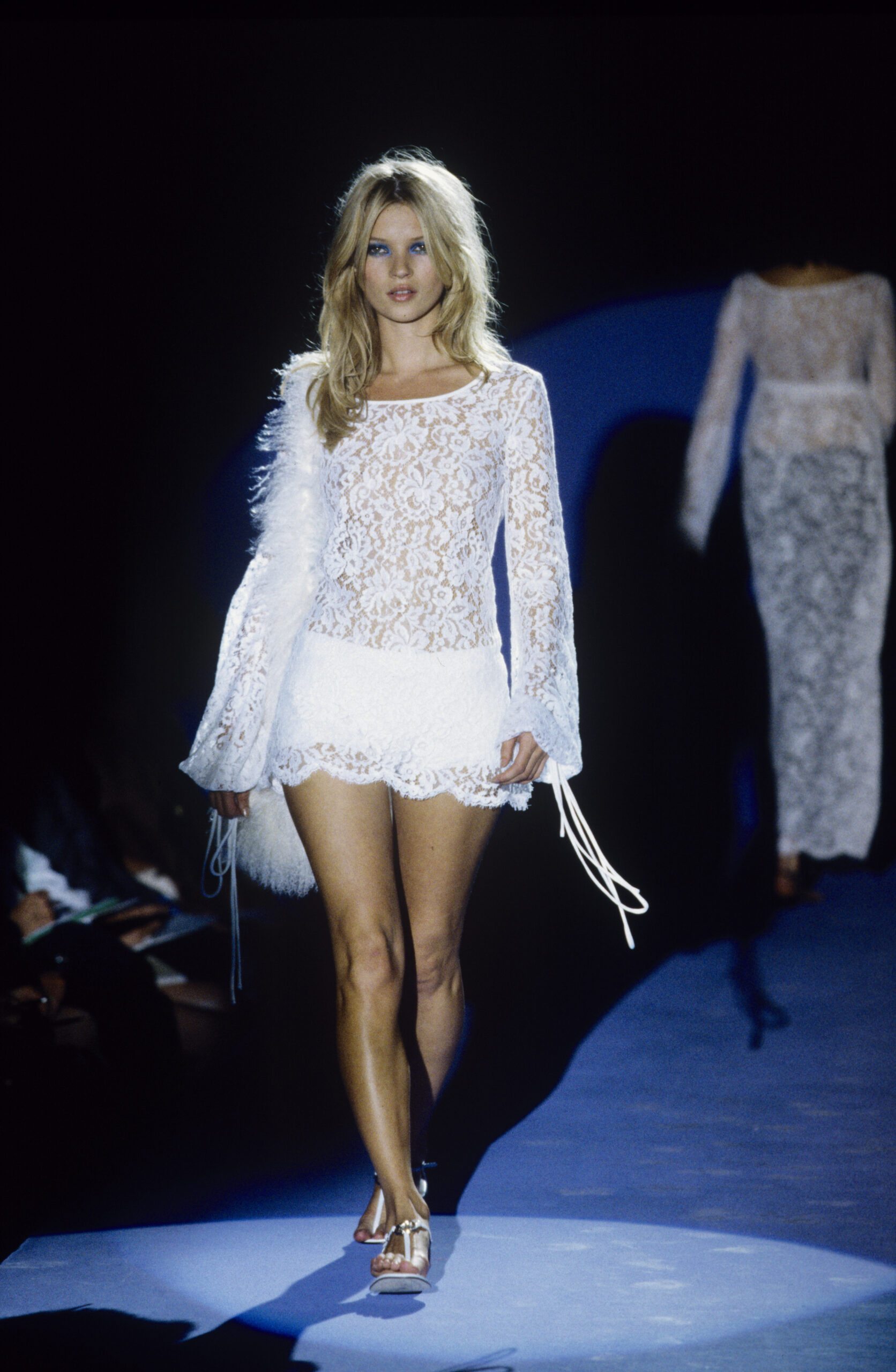
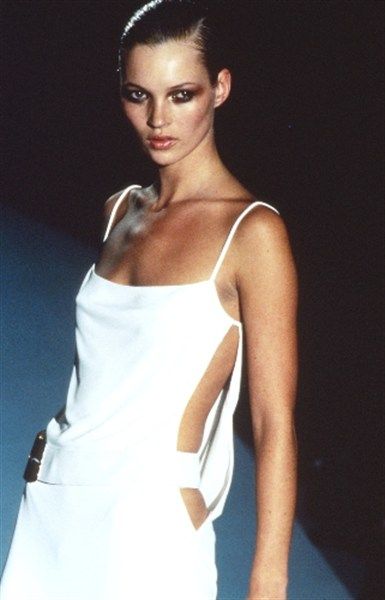
Photo: Davide Maestri/Getty Images, Getty
Chloé's, SS94 & SS98
Kate Moss appeared on Chloé’s runway throughout the 90s, spanning both of its defining creative eras, Karl Lagerfeld’s and Stella McCartney’s.
The first runway look falls right in the middle of Lagerfeld’s return to Chloé, where he came back to the house in 1992 after a nine-year absence. His early-to-mid-90s tenure there leaned into a romantic, slightly gypsy, bohemian mood, with light fabrics, ethnic-inspired jewelry, headscarves, and bare midriffs; this particular look fits squarely into that sensibility.
The second look is from Chloé Spring/Summer 1998, and it’s a genuinely famous moment for a specific reason: it was Stella McCartney’s debut collection as creative director of Chloé, shown October 14, 1997 at the Paris Opera. She was just 25 years old, which made her the youngest designer to head the French house, and after only two prior collections under her own name at Central Saint Martins. McCartney stacked her runway with her own real-life friends who happened to be the era’s biggest supermodels, Kate Moss, Naomi Campbell, Yasmin Le Bon, and Jodie Kidd among them.
The dress itself is a strapless powder-blue silk bustier top with a fitted, ruched bodice, worn with a dramatically draped satin skirt that wraps asymmetrically across the hip, revealing an ivory underlayer beneath with delicate floral beading and tassels visible along the hem. It fits right into what critics noted about McCartney’s early Chloé work more broadly, a sensual, body-conscious softness with a strong 70s undertone, a real shift from Lagerfeld’s more romantic, folkloric direction just seasons before. Such a beautiful dress for the wedding party that also could be something blue.
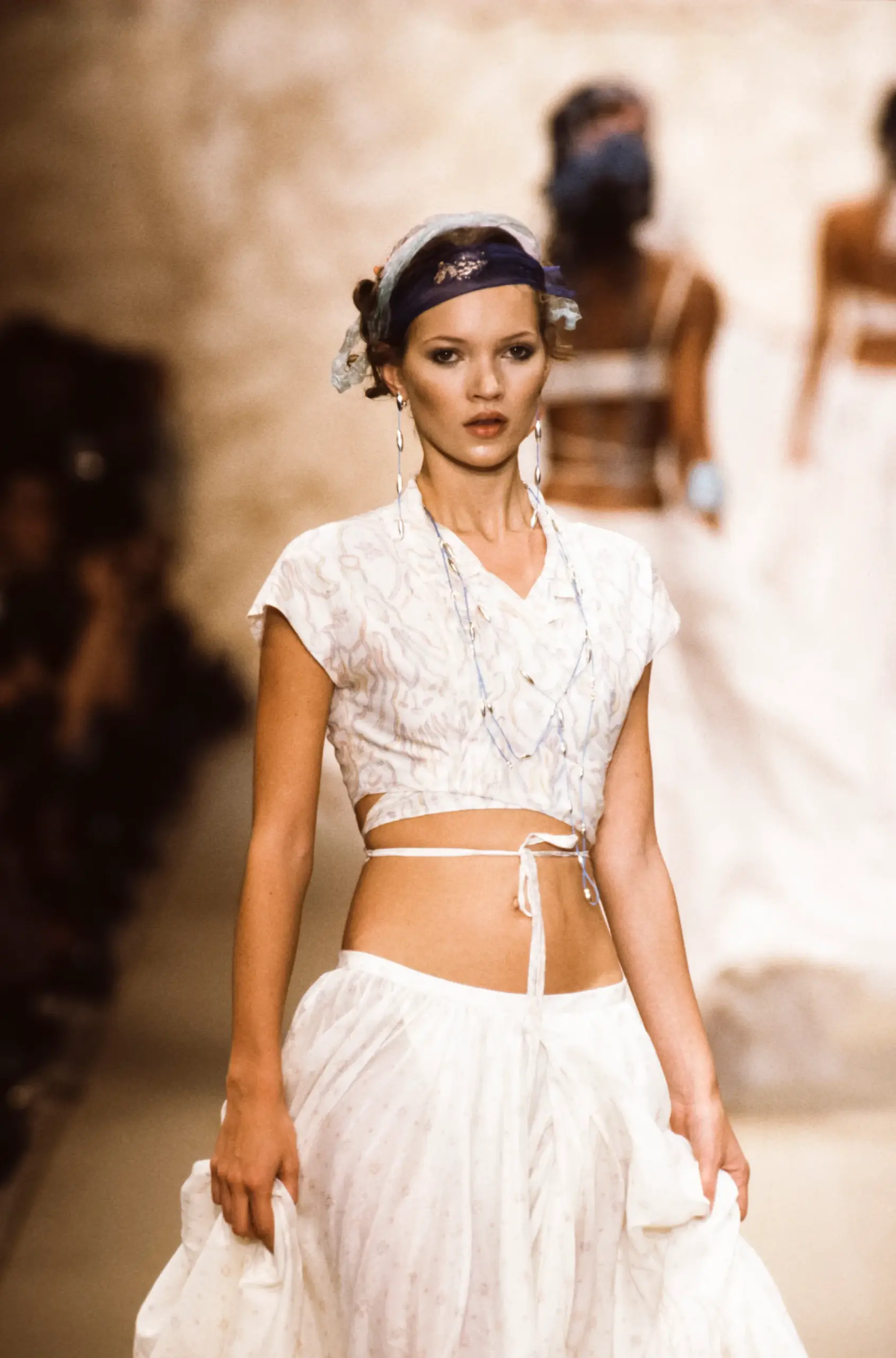
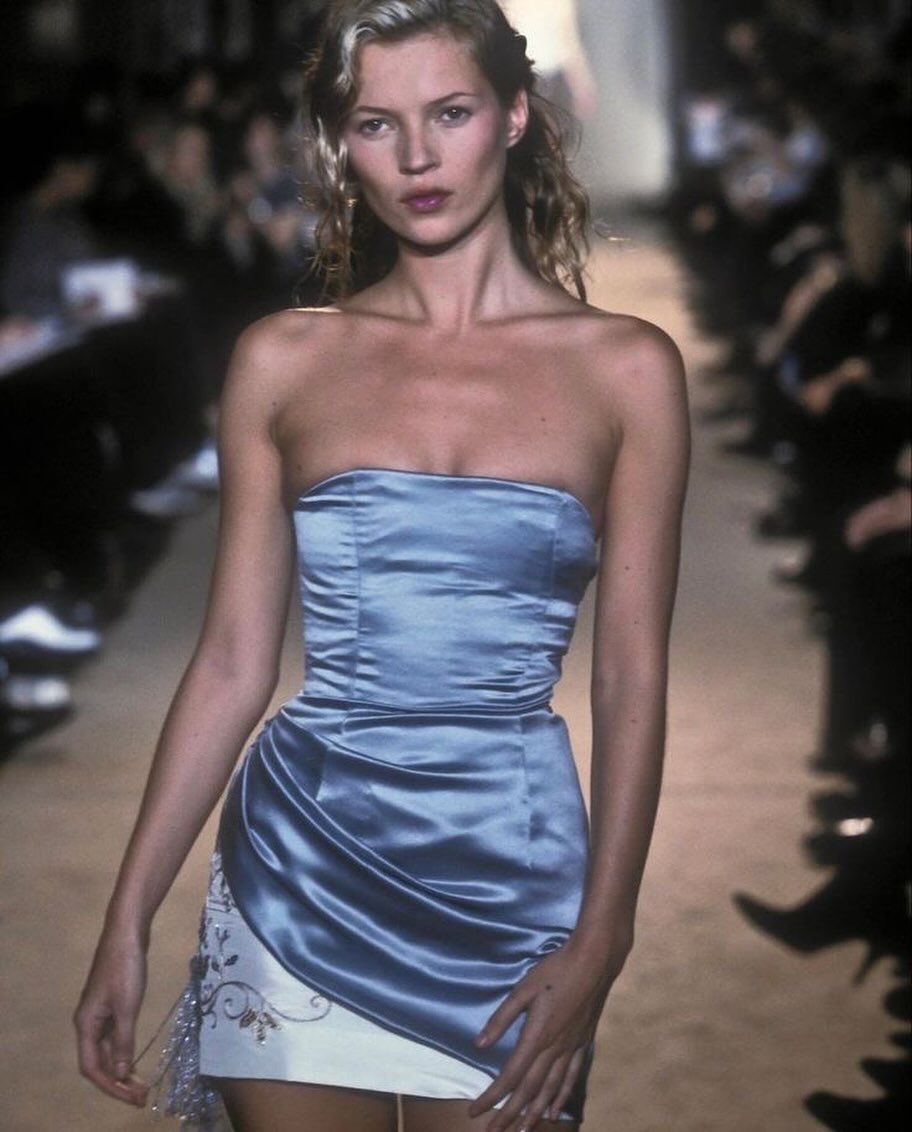
Photo: Pool ARNAL/PAT, Getty
Givenchy, SS96 & Haute Couture AW96
John Galliano was creative director at Givenchy for exactly two couture seasons before moving to Dior, Spring/Summer 1996 and Fall/Winter 1996.
Shown in January 1996 at the Stade de France in Paris, this was Galliano’s very first collection for the house. Moss’s look here is a white satin gown with a sculptural cascade of sheer organza ruffles wrapping one shoulder and side, worn with a dramatic, oversized, bow-shaped headpiece, and her hair styled into two sculpted buns. It’s a good example of what made the debut so talked about: structured, almost architectural drama layered onto classic couture materials.
Galliano’s second and final Givenchy couture collection took its theme from Edmond Rostand’s 1895 romantic play of the same name, “The Faraway Princess.” The model was walking in a sheer, floral-embroidered lace gown with an empire waist and short puffed sleeves, worn with a powdered, almost 18th-century-style updo. It’s a fun reference point for a bold bride eyeing a naked dress moment of her own. By the way, Jennifer Lawrence wore this exact archival piece to the 2024 Vanity Fair Oscars party, ditching the wig but keeping the sheer floral drama fully intact.
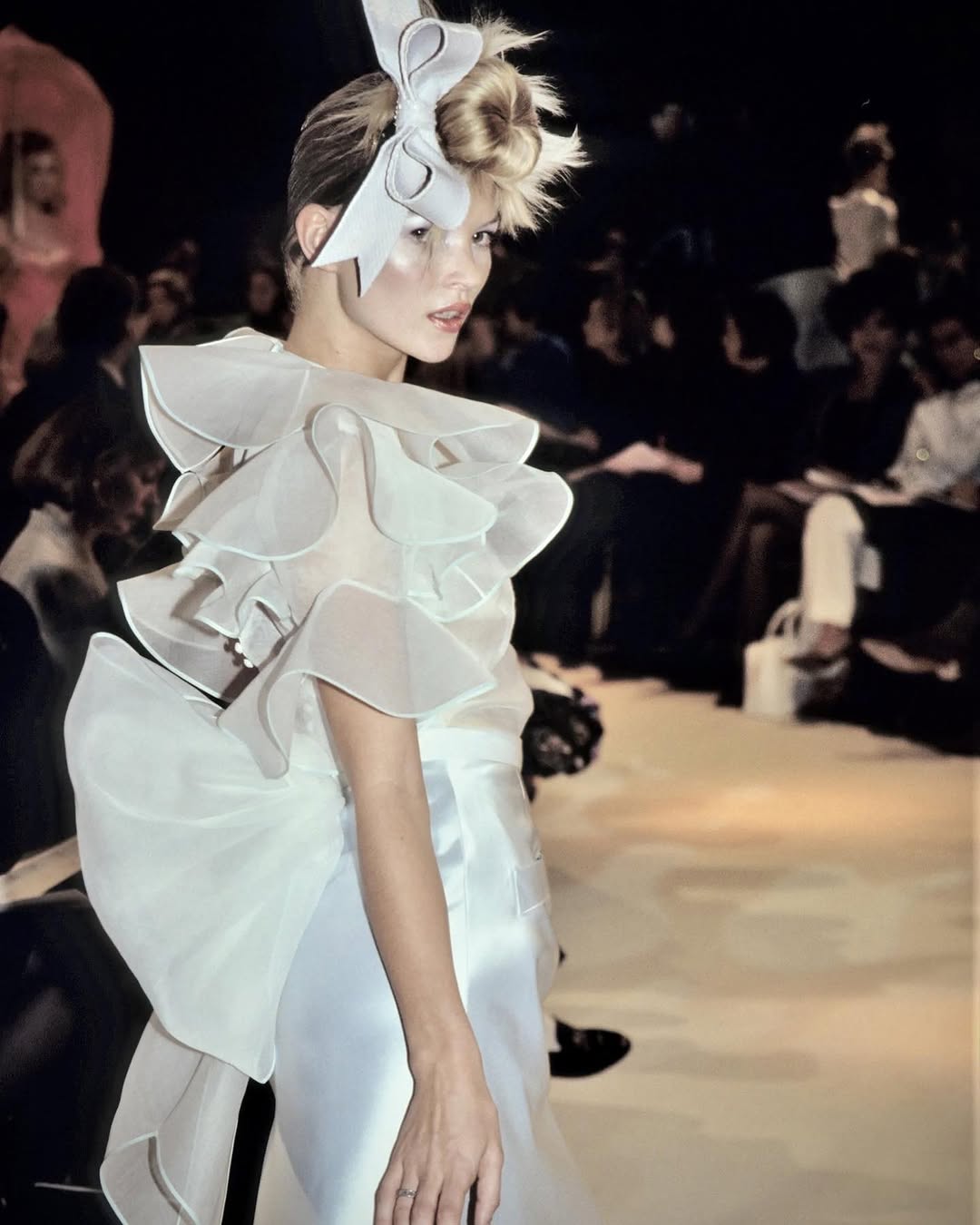
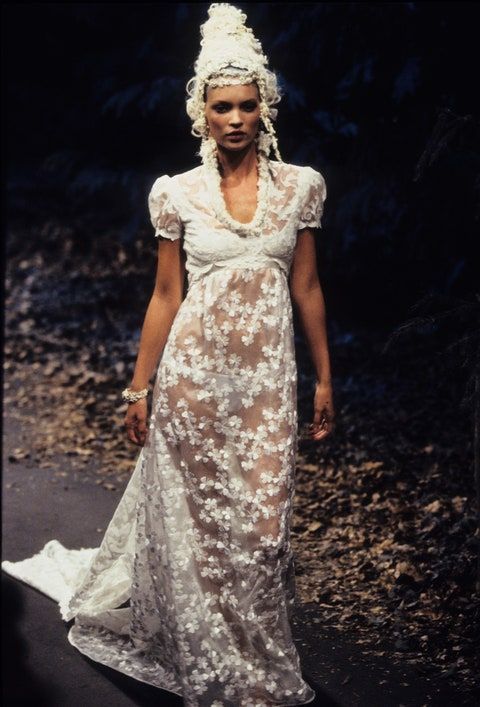
Photo: Getty, Condé Nast Archive
New York, 1995 & London, 1999
Kate Moss attended the New York premiere of Johnny Depp’s movie “Ed Wood” in 1994, walking the carpet hand in hand with Depp, who starred in the movie. She wore a sheer, silver beaded fringe slip dress with a dropped waist, the classic flapper silhouette rendered in fine chain-like beading, paired with white Mary Jane heels and a simple pearl necklace. It’s a quieter, less publicized moment than some of her more famous party looks, but the dress itself, beaded, sheer, unmistakably 1920s in spirit, is exactly the kind of reference a bride chasing old Hollywood glamour without the weight of a full ball gown should be looking at.
In June 1999, Kate Moss and Naomi Campbell attended this joint De Beers and Versace event in matching metallic chainmail mini dresses, Moss’s a plain silver mesh slip, Campbell’s version detailed with pink and blue crystal butterfly appliqués across the bodice. The look became one of the most-referenced “Versace angels” moments of the decade: smoky eyes, liquid-metal fabric, minimal jewelry beyond a statement necklace. It’s been recreated enough times since (Kylie Jenner wore a version of the same archival chainmail dress to the 2025 Golden Globes) that it’s practically its own genre of party dressing at this point.
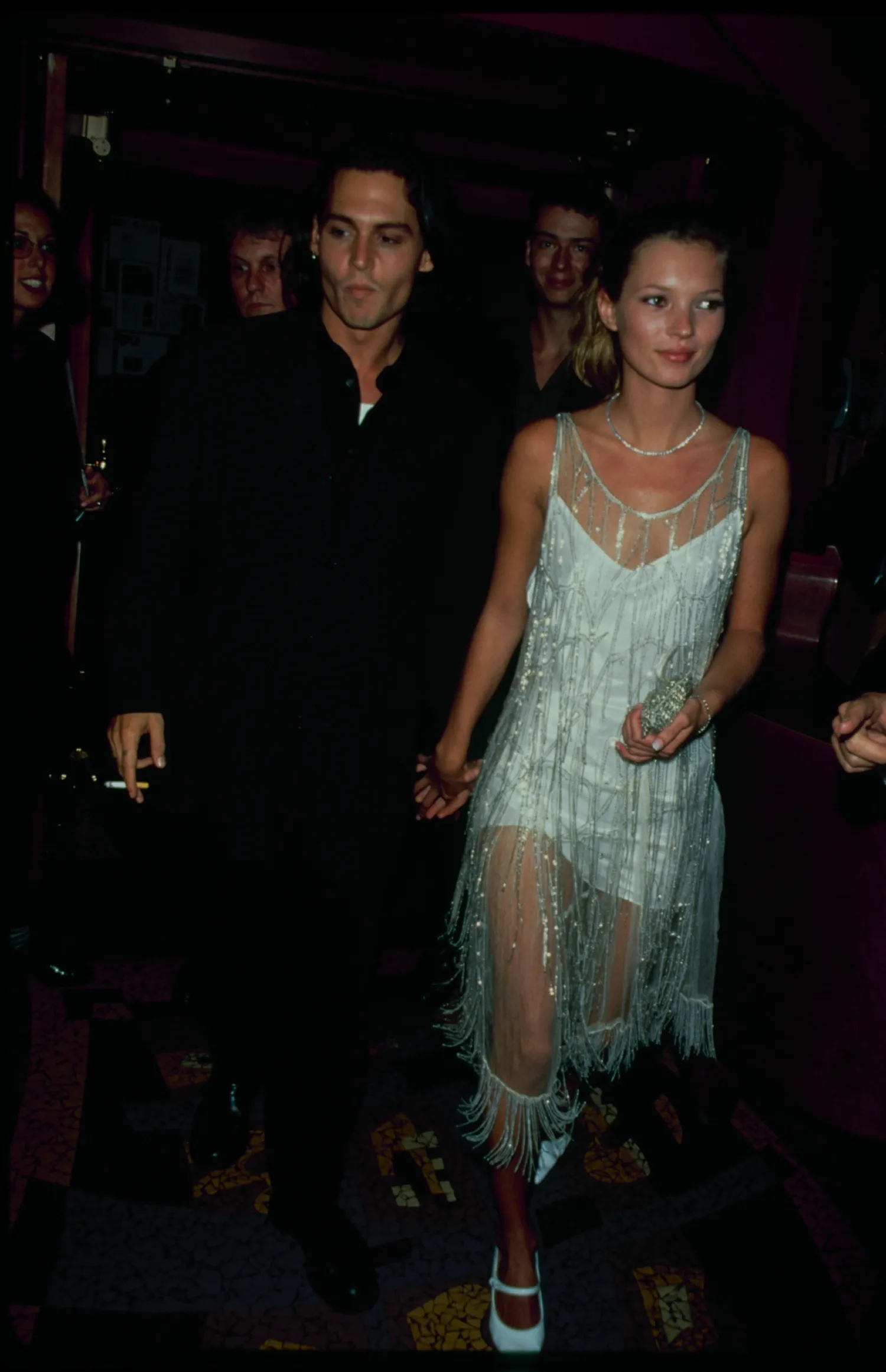
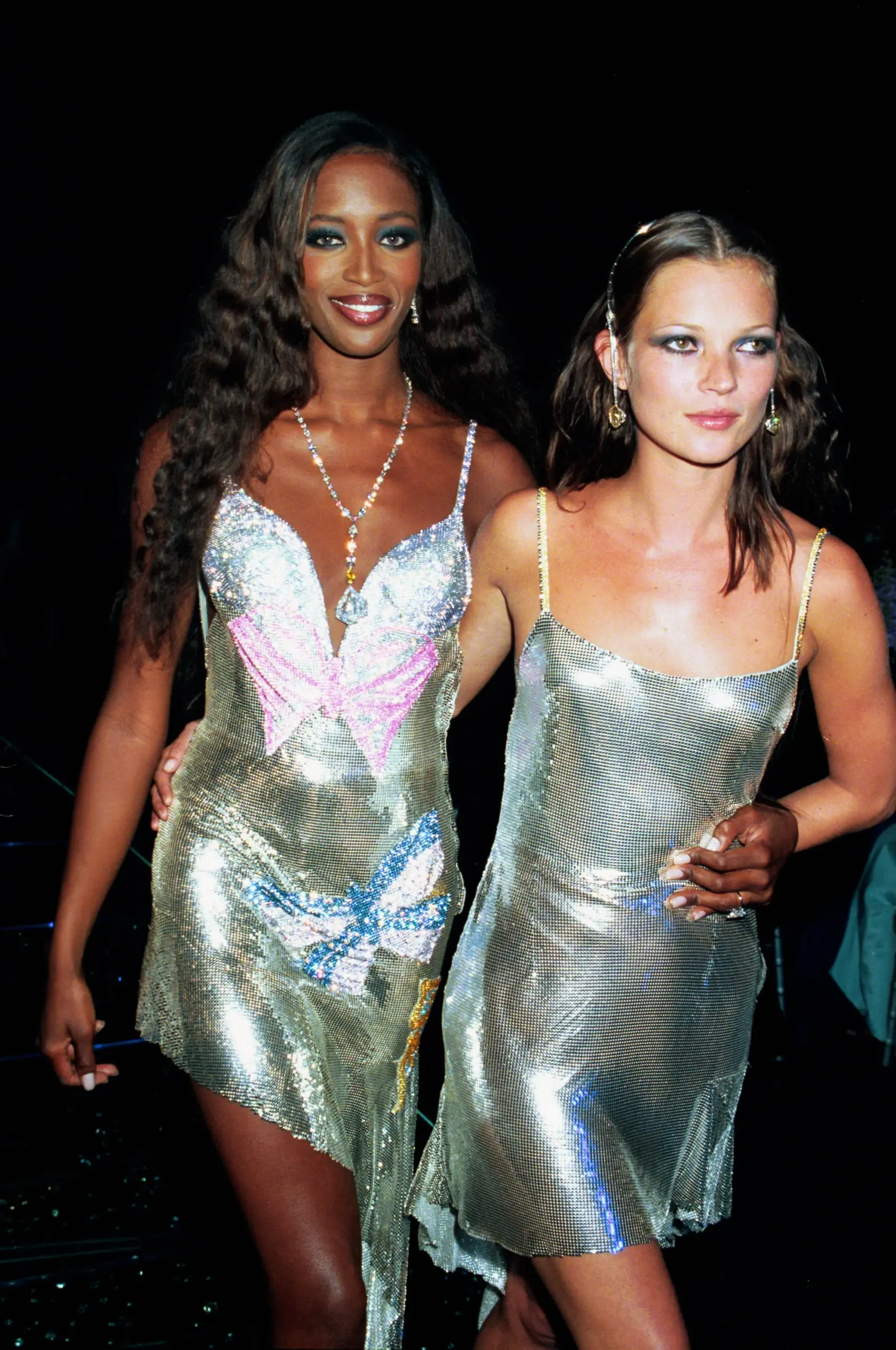
Photo: Getty, Dave Benett/Getty Images